

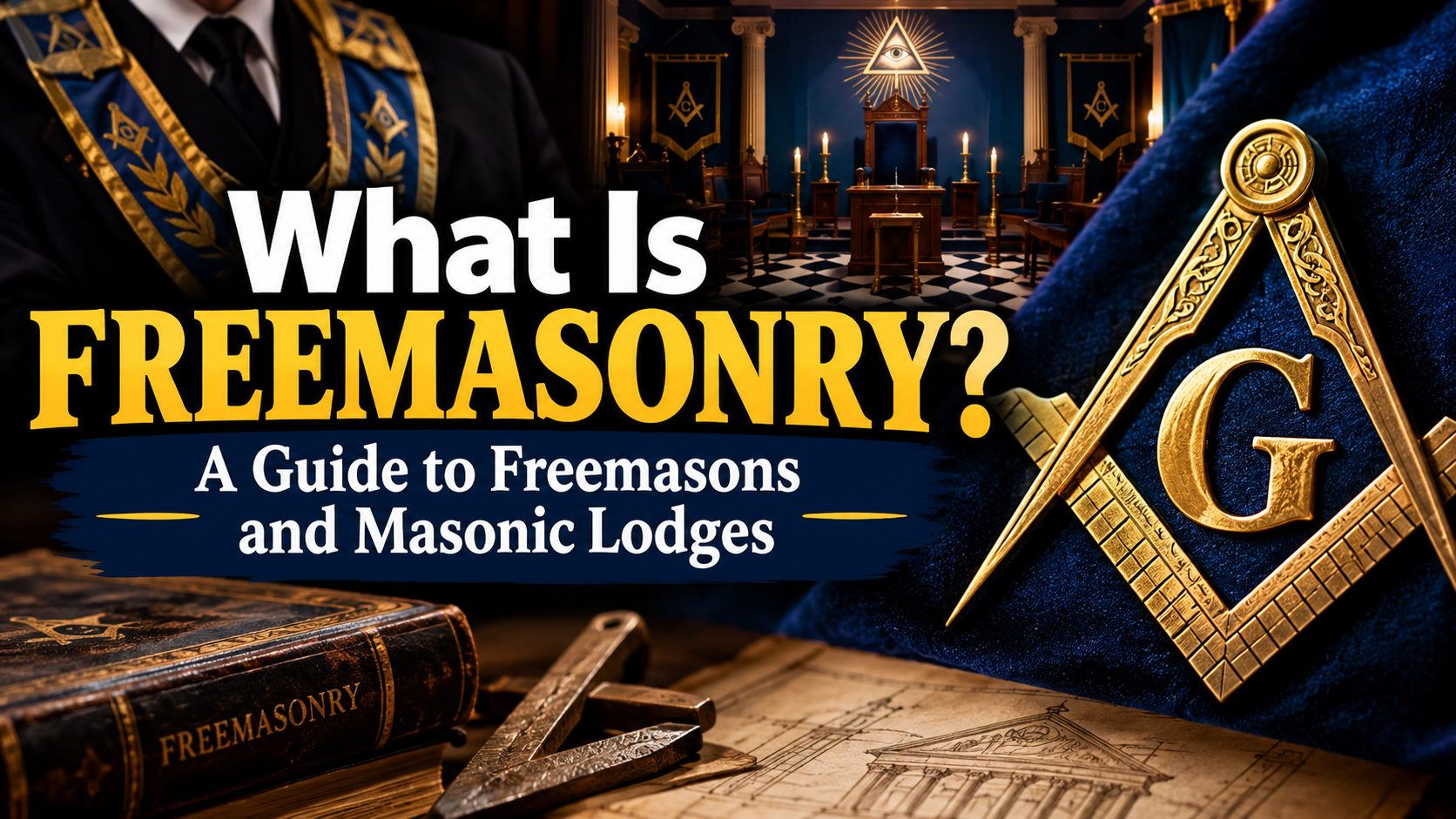
What Is Freemasonry? A Guide to Freemasons and Masonic Lodges
Freemasonry is one of the oldest fraternal organizations in the world, built around fellowship, moral development, personal improvement, and service to others. A person who belongs to it is called a Freemason, or simply a Mason. Freemasons traditionally meet in local organizations known as Masonic lodges, where members take part in meetings, ceremonies, education, social activities, and charitable work.
Although Freemasonry has roots in European traditions associated with stonemasonry, the organization developed into a fraternal society with its own customs, symbols, degrees, and forms of recognition. In the United States, Freemasonry has been part of civic and community life since the colonial period, with the first known American lodge established in 1731.
Today, Freemasonry is not a single worldwide organization controlled by one central authority. It consists of separate Masonic jurisdictions and Grand Lodges, with traditions and membership requirements that can vary. Its history in America also includes distinct traditions such as Prince Hall Freemasonry, which has played an important role in African American history.
So, what exactly is Freemasonry, what do Freemasons believe, and what happens inside a Masonic lodge? Understanding the organization starts with its basic meaning and purpose.
What Does Freemasonry Mean?
Freemasonry, also known as Masonry, is a fraternal organization whose members come together through local Masonic lodges for fellowship, moral and personal development, education, and service to their communities. A member of the organization is called a Freemason or Mason.
The word Freemasonry describes the institution and its traditions, while Freemason refers to an individual member. Although the organization uses terminology and symbols connected with traditional stonemasonry, modern Freemasonry is not a trade organization for builders or stoneworkers.
Freemasonry is organized primarily through local lodges. These lodges provide the setting where members meet, conduct organizational business, participate in Masonic ceremonies, learn about the fraternity's teachings and traditions, and take part in social or charitable activities. Individual lodges generally operate under the authority of a Grand Lodge within a particular Masonic jurisdiction.
The organization also uses a system of degrees to mark stages of a Mason's progress. In traditional Craft or symbolic Masonry, these are the Entered Apprentice, Fellow Craft, and Master Mason degrees. Each degree uses ceremonies and symbolism to communicate lessons about character, conduct, responsibility, and personal development.
What Is a Freemason?
A Freemason is a person who has joined a Masonic lodge and undergone the membership process established by that lodge and its governing jurisdiction. Becoming a Freemason is therefore more than simply identifying with Masonic ideas; membership involves a formal process that can include an application or petition, approval by the lodge, and initiation.
The exact requirements and procedures differ among Masonic jurisdictions. In the United States, individual Grand Lodges govern Freemasonry within their respective jurisdictions, so requirements should be checked with the relevant Grand Lodge or local lodge.
Is Freemasonry a Fraternity?
Yes. Freemasonry is commonly described as a fraternal organization because it brings members together through shared traditions, fellowship, ceremonies, and mutual support.
However, fraternity is only one part of its identity. Masonic organizations also emphasize moral instruction, self-improvement, charitable service, and community involvement. These purposes are expressed through lodge activities, Masonic education, ceremonies, and the symbolic lessons associated with the degrees.
Is Freemasonry a Religion?
Freemasonry is not itself a religion and does not function as a substitute for a member's religious faith. At the same time, religious belief has historically had a place in many Masonic traditions.
Requirements vary by jurisdiction and Masonic body. For example, regular Masonic traditions in the Anglo-American world commonly require candidates to profess belief in a Supreme Being, while Freemasonry generally does not prescribe a particular religion for its members.
This distinction is important because Freemasonry's ceremonies and language can contain references to God, morality, and spiritual subjects without making the fraternity itself a religion.
With its basic meaning established, the next question is what Freemasonry actually teaches its members and which principles guide Masonic life.
What Do Freemasons Believe?
Freemasonry does not have one universal creed that defines the beliefs of every Mason. Masonic requirements and practices can differ between jurisdictions and organizations. However, traditional Freemasonry commonly places emphasis on moral conduct, personal responsibility, brotherhood, respect, charity, and service.
Rather than asking members to follow a particular political or philosophical ideology, Masonic teachings generally use symbols, ceremonies, and lessons to encourage members to examine their own character and conduct.
Moral and Ethical Development
A central purpose of Freemasonry is to encourage members to become more responsible and ethical people. Masonic teachings commonly address qualities such as honesty, integrity, self-discipline, fairness, and responsibility toward others.
These lessons are often communicated through the symbolism and ceremonies associated with the Masonic degrees. The underlying idea is that becoming a better member of a community begins with working on one's own character.
Brotherhood and Fellowship
Brotherhood is another important part of Masonic life. Members meet through their local lodges, develop relationships with other Masons, and participate in activities outside formal ceremonies.
This fellowship is not limited to socializing. The lodge provides a setting where members from different occupations and backgrounds can meet through a shared fraternal tradition.
Charity and Service
Masonic organizations also have a long tradition of charitable giving and community service. Individual lodges and larger Masonic organizations may support charitable programs, educational initiatives, community projects, and assistance for people in need.
The specific programs vary by jurisdiction, but service to others is a recurring theme in Masonic organizations.
Personal Improvement
Freemasonry also encourages members to view membership as a process of self-improvement. Its degrees use symbolic lessons to explore ideas about conduct, responsibility, knowledge, and the way a person should relate to others.
This is why Masonic education is not limited to learning organizational rules. Members may study Masonic history, symbolism, philosophy, and the traditions of their own jurisdiction.
Belief in a Supreme Being
Religious belief is treated differently across Masonic organizations. In regular Anglo-American Freemasonry, belief in a Supreme Being is generally an eligibility requirement, but Freemasonry does not require members to belong to one specific religion.
For example, the United Grand Lodge of England identifies belief in a Supreme Being as a requirement for membership while stating that Freemasonry does not seek to replace a person's religion. Requirements in the United States should be understood according to the rules of the relevant Grand Lodge.
These principles help explain what Freemasonry seeks to accomplish, but they do not yet explain how the organization operates in practice. To understand that, it is necessary to look at the Masonic lodge, the basic organizational setting where Freemasons meet and participate in Masonic life.
How Does Freemasonry Work?
Freemasonry is organized around local Masonic lodges, where members meet and take part in the activities of the fraternity. Lodges handle much of the day-to-day life of Freemasonry, including meetings, ceremonies, Masonic education, fellowship, and charitable activities.
There is no single worldwide organization that governs every Freemason. Instead, Freemasonry is organized through separate jurisdictions, usually under Grand Lodges. This structure is particularly important in the United States, where individual Grand Lodges generally have authority over Freemasonry within their respective jurisdictions.
What Is a Masonic Lodge?
A Masonic lodge is both a local organization of Freemasons and, depending on context, the place where those members meet.
A local lodge is where members conduct regular business, hold Masonic ceremonies, participate in educational programs, socialize with other members, and organize charitable or community activities. Lodges may have their own officers who are responsible for carrying out different organizational duties.
The lodge is therefore the basic unit through which most members experience Freemasonry.
What Happens at a Masonic Lodge Meeting?
A lodge meeting can include several different types of activity. Some meetings focus on administrative matters, such as organizational business, membership, finances, or planning upcoming activities. Others may involve Masonic degree ceremonies, educational presentations, or discussions.
Lodges may also organize dinners, social gatherings, fundraising activities, and community-service projects outside formal lodge meetings.
The exact format varies by lodge and jurisdiction, so there is no single schedule or meeting format followed by every Masonic lodge.
What Is a Grand Lodge?
A Grand Lodge is a governing Masonic body responsible for a particular jurisdiction. Its responsibilities can include establishing rules and regulations for subordinate lodges, issuing charters, overseeing standards, and maintaining the organizational structure of Freemasonry within its jurisdiction.
The term can sometimes cause confusion because Freemasonry does not have one universal Grand Lodge governing all Masons worldwide.
In the United States, Masonic governance is primarily organized on a state or jurisdictional basis. This means that the rules, membership requirements, and some practices can differ between Grand Lodges.
How Is Freemasonry Organized in the United States?
American Freemasonry developed through separate Masonic jurisdictions rather than through one national governing organization. Local lodges operate under their respective Grand Lodges, which maintain authority within their jurisdictions.
This decentralized structure helps explain why a statement about Freemasonry may be accurate in one jurisdiction but not necessarily apply to every Masonic organization in the United States.
It also matters when discussing membership requirements, ceremonies, recognition between Masonic bodies, and other aspects of Masonic practice. For questions about joining or local rules, the relevant Grand Lodge or lodge is the appropriate source of information.
With the lodge and governing structure established, the next step is to understand how a member progresses within traditional Craft Masonry. That progression is organized around three principal degrees: Entered Apprentice, Fellow Craft, and Master Mason.
What Are the Three Degrees of Freemasonry?
Traditional Craft or symbolic Freemasonry is organized around three principal degrees: Entered Apprentice, Fellow Craft, and Master Mason. The degrees represent stages in a member's progression through the fraternity and use ceremonies, symbols, and moral lessons to communicate different aspects of Masonic teaching.
The three degrees are not simply ranks based on social status. Each represents a stage of Masonic instruction and participation, with the third degree completing the basic sequence of Craft Masonry.
First Degree: Entered Apprentice
The Entered Apprentice is the first degree of Freemasonry and marks the beginning of a person's formal progression as a Mason.
At this stage, the candidate is introduced to fundamental Masonic principles, traditions, symbols, and expectations. The degree emphasizes the importance of learning, moral conduct, and beginning the process of personal improvement.
The terminology reflects the organization's historical connection with the language and traditions of operative stonemasonry, where an apprentice would begin by learning the skills of the craft.
Second Degree: Fellow Craft
The Fellow Craft is the second degree. It represents a further stage of learning and development within Craft Masonry.
The degree traditionally places greater emphasis on education, knowledge, intellectual development, and continued personal growth. Like the other degrees, its lessons are communicated through Masonic symbolism and ceremony.
After progressing through this degree, a Mason continues toward the third and final degree of Craft Masonry.
Third Degree: Master Mason
The Master Mason degree is the third degree and completes the basic sequence of Craft or symbolic Freemasonry.
It is traditionally associated with deeper lessons concerning character, responsibility, mortality, and the obligations of a Mason. Completion of the degree establishes the member as a Master Mason within the relevant Masonic jurisdiction.
Master Mason is therefore an important point of distinction when discussing Masonic degrees: it is the third degree of Craft Masonry, rather than simply another title within a long ladder of universally recognized ranks.
Is the 33rd Degree Higher Than Master Mason?
The commonly mentioned 33rd degree belongs to the Scottish Rite, a separate Masonic body that provides additional degrees and activities beyond the three degrees of Craft Masonry.
This does not mean that a Mason normally progresses from the first degree through the 33rd as one continuous universal system. The three Craft degrees—Entered Apprentice, Fellow Craft, and Master Mason—form the foundational sequence. Scottish Rite degrees are an additional system available to eligible Master Masons, with their own organizational structure and terminology.
Other Masonic bodies, such as the York Rite, also have their own degrees or orders. These should therefore be understood as additional Masonic organizations and systems rather than replacements for the three foundational Craft degrees.
The degrees are closely connected with another distinctive feature of Freemasonry: its use of symbols and ritual to communicate moral and philosophical lessons. Understanding that symbolism helps explain why Masonic ceremonies look different from an ordinary fraternal meeting.
Why Does Freemasonry Use Symbols and Rituals?
Symbols and ceremonies are an important part of how Freemasonry communicates its teachings. Rather than presenting every lesson as a straightforward rule, Masonic traditions often use familiar objects, actions, and ideas from the language of stonemasonry to represent qualities such as discipline, fairness, responsibility, and moral conduct.
This symbolic approach is one of the features that distinguishes Masonic education from an ordinary social or professional organization.
Where Do Masonic Symbols Come From?
Many traditional Masonic symbols are connected to the tools and practices of operative stonemasons, including the square, compasses, level, and plumb.
Modern Freemasonry uses these objects primarily as symbols rather than as working tools. Their practical functions provide a framework for communicating moral lessons. For example, the idea of measuring, building, or maintaining a structure can be used symbolically to discuss how a person should conduct their own life.
The exact interpretation of individual symbols can vary between Masonic traditions and jurisdictions, so a single explanation should not necessarily be treated as universal.
What Do Masonic Tools Symbolize?
The square and compasses are among the most recognizable symbols associated with Freemasonry. They are commonly displayed together in Masonic settings and are associated with moral and ethical instruction.
Other traditional working tools also appear in Masonic symbolism. Their meanings are presented through the ceremonies and educational traditions of the degrees rather than being limited to their original practical functions.
This is why Masonic symbolism is best understood in context: the object itself is only part of the lesson, while the surrounding ceremony and explanation provide its intended meaning.
Why Does Freemasonry Use Ritual?
Masonic ritual refers to the formal ceremonies through which the degrees and other aspects of Masonic life are conducted. Ritual provides a structured way of presenting Masonic teachings and traditions from one generation of members to the next.
The ceremonies can include symbolic actions, traditional language, questions and responses, and forms of recognition. They are intended to make the lessons of the degrees memorable and meaningful to participants.
Because some portions of Masonic ritual are treated as private by Masonic organizations, detailed descriptions of ceremonies can vary in publicly available sources. The existence of private ritual, however, should not be confused with the entire organization being hidden.
Why Are Some Masonic Ceremonies Private?
Freemasonry distinguishes between information that is publicly available and elements that members traditionally agree to keep private. Masonic organizations openly describe their history, principles, lodge structure, charitable activities, and membership opportunities, while certain ceremonial details and traditional forms of recognition may be reserved for members.
This distinction helps explain why Freemasonry has sometimes been described as a "secret society." The organization itself is publicly identifiable, but some aspects of its ceremonies and traditions are intentionally private.
That leads to an important question: if Freemasonry is a publicly organized fraternity but keeps some traditions private, is it actually a secret society?
Is Freemasonry a Secret Society?
Freemasonry is often described as a secret society, largely because some of its ceremonies, traditional forms of recognition, and other practices are private. However, Masonic organizations generally distinguish between keeping certain practices private and being a completely hidden organization.
Freemasonry is publicly organized. Masonic lodges have identifiable locations, Grand Lodges publish information about their history and rules, and Masonic organizations openly discuss their principles, charitable activities, and membership procedures.
What Is Public About Freemasonry?
Much of Freemasonry can be studied through public sources. Its history, organizational structure, charitable work, symbols, membership requirements, and many of its traditions have been documented in books, archives, museums, and Masonic publications.
Individual Masons may also openly identify themselves as members, and many lodges publicly provide information about their activities and how prospective members can make contact.
In the United States, Masonic organizations operate through established jurisdictions and Grand Lodges rather than through a single hidden national organization.
What Remains Private?
Certain aspects of traditional Masonic practice are reserved for members. These can include portions of degree ceremonies, traditional modes of recognition, passwords, signs, and other elements that Masons have historically agreed not to disclose publicly.
The purpose of keeping these elements private is connected to the traditions of the fraternity and the experience of participating in its ceremonies. The precise rules governing what is private can differ between Masonic jurisdictions.
Why Is Freemasonry Associated With Secrecy?
The association comes partly from the organization's historical practice of protecting particular ceremonial elements from public disclosure. Over time, this privacy, combined with the use of symbolism and ceremonial language, contributed to the popular image of Freemasonry as a secretive organization.
That image has also been reinforced by fictional portrayals and conspiracy theories that go beyond what can be established from reliable historical and organizational sources.
It is therefore useful to make a simple distinction:
Freemasonry is a publicly identifiable fraternal organization that maintains privacy around certain traditional practices.
Understanding that distinction provides a more accurate starting point for examining Freemasonry's role in American history. The fraternity has existed in the United States since the colonial period and became part of the country's broader tradition of voluntary associations.
Freemasonry in the United States
Freemasonry has been part of American history since the colonial period. The fraternity developed in the American colonies through local lodges and eventually became established across the country through separate Masonic jurisdictions. Its history in the United States is therefore closely connected with the broader history of voluntary associations, community organizations, and fraternal societies.
When Did Freemasonry Come to America?
Freemasonry was established in the American colonies during the 18th century. The Library of Congress identifies 1731 as the date of the first known Masonic lodge in America. From these early beginnings, Masonic lodges spread to other colonies and later became part of the developing civic and social institutions of the United States.
As American Freemasonry expanded, individual jurisdictions developed their own governing structures. This historical development helps explain why American Freemasonry is organized through multiple Grand Lodges rather than one national Masonic authority.
Freemasonry and the American Founding Era
Freemasonry was present in colonial and early American society, and several prominent figures of the period were members. This historical connection is documented, but it is important to distinguish between individual membership and claims that Freemasonry as an organization directed major political events.
One of the best-known examples is George Washington. Library of Congress records document his Masonic membership, including his initiation in Fredericksburg, Virginia, in 1752 and his progression to Master Mason in 1753.
Washington's membership is one reason Freemasonry frequently appears in discussions of America's founding period. It demonstrates the presence of Masonry within the social networks of the era, but it does not by itself establish that Masonic organizations controlled or directed the American Revolution or the formation of the United States.
George Washington and Freemasonry
George Washington remained associated with Freemasonry throughout his public life. Historical Masonic records and Library of Congress collections document his membership and his connection with Masonic organizations.
His example also illustrates how prominent Americans could participate in voluntary and fraternal organizations alongside their political, military, and professional activities. Washington's Masonic membership is therefore an important part of the history of both the individual and American Freemasonry.
Prince Hall Freemasonry
The history of Freemasonry in the United States also includes Prince Hall Freemasonry, an important African American Masonic tradition.
Prince Hall and fourteen other free Black men were initiated into Freemasonry in Boston on March 6, 1775. They subsequently organized African Lodge No. 1, and in 1784 the lodge received a charter from the Grand Lodge of England, becoming African Lodge No. 459. The Library of Congress describes Prince Hall Freemasonry as the oldest recognized and continuously active organization founded by African Americans.
Prince Hall Freemasonry developed within the context of racial exclusion in American society. Its organizations became important institutions for African American community life, education, civic participation, and mutual support. The Library of Congress also documents the involvement of Prince Hall Masons in later African American civic and civil-rights activity.
Including Prince Hall Freemasonry is essential to understanding the American Masonic landscape because the history of U.S. Freemasonry is not represented by a single organizational tradition.
From its colonial beginnings to the development of multiple Masonic jurisdictions and traditions, Freemasonry has undergone significant changes in the United States. The next question is how large the fraternity is today and how its membership has changed over time.
How Many Freemasons Are There in the United States?
Freemasonry remains a large fraternal organization in the United States, although its membership is substantially smaller than it was during the middle of the 20th century.
According to the Masonic Service Association of North America (MSANA), U.S. Masonic membership totaled 869,429 members in 2023. MSANA's historical series shows that membership has declined considerably from the middle of the 20th century, when it reached its highest recorded level of 4,103,161 members in 1959.
The change becomes clearer when several years are compared:
| Year | U.S. Masonic membership |
|---|---|
| 1959 | 4,103,161 |
| 2000 | 1,841,169 |
| 2010 | 1,373,453 |
| 2020 | 942,195 |
| 2021 | 919,129 |
| 2022 | 881,219 |
| 2023 | 869,429 |
These figures show a long-term decline rather than a recent change limited to a single year. Between 2010 and 2023, the reported U.S. membership fell from approximately 1.37 million to 869,000.
Why Do Membership Numbers Vary?
Masonic membership statistics should be interpreted carefully because Grand Lodges do not necessarily use identical methods for counting members.
MSANA explains that some Grand Lodges may include Entered Apprentices in their totals, while others count only Master Masons. Some jurisdictions can also count members who hold memberships in more than one lodge. As a result, membership totals are useful for understanding broad trends but should not be treated as perfectly standardized measurements across every jurisdiction.
The Library of Congress has also documented the historical scale of American Freemasonry, noting its peak of more than four million members in the late 1950s. Its broader historical discussion places Freemasonry within America's long tradition of voluntary and fraternal associations.
The membership figures provide one measure of how Freemasonry has changed over time, but numbers alone do not explain what members actually do. To understand the organization today, it is useful to look at the activities that take place within lodges and the ways Freemasons participate in th
What Do Freemasons Do?
Freemasonry is more than its ceremonies and degree system. Much of a Mason's experience takes place through lodge meetings, fellowship, education, charitable activities, and community service.
The exact activities vary from one lodge and jurisdiction to another, but the basic idea is consistent: members use the organization as a setting for personal development, friendship, and service. The Masons of California, for example, describes Freemasonry as combining personal development, friendship, and community service.
Lodge Meetings
Regular lodge meetings are an important part of Masonic life. Members may conduct lodge business, discuss membership matters, plan activities, receive reports, and participate in Masonic ceremonies.
Some meetings focus primarily on administrative matters, while others may involve degree work or Masonic education. The specific format depends on the lodge and its governing jurisdiction.
A lodge is therefore both a fraternal organization and a place where members maintain the traditions and activities of Freemasonry.
Fellowship and Social Activities
Freemasonry also provides opportunities for members to develop friendships and spend time together outside formal lodge business.
Depending on the lodge, activities can include meals, social gatherings, sporting events, lectures, outings, and family-oriented events. Masonic organizations describe fellowship as an important part of membership, alongside personal development and service.
These activities help explain why Freemasonry is described as a fraternity rather than simply an organization built around ceremonies.
Education and Personal Development
Masons may also participate in educational programs, discussions, lectures, and study of Masonic history and symbolism.
Personal development is another recurring theme. Masonic organizations describe their teachings as encouraging members to reflect on character, responsibility, leadership, and their relationships with others. The Masons of California, for example, identifies personal development as one of the central purposes of modern Freemasonry.
This educational side of Masonry connects directly to the symbolic lessons introduced through the three degrees.
Charity and Community Service
Charitable work and community service are also significant parts of Masonic activity.
Individual lodges may support local causes through fundraising, donations, volunteering, educational initiatives, youth programs, or assistance for people in their communities. Masonic organizations can also operate larger charitable programs at the state or national level.
For example, the Masons of California reports that its lodges support local causes and that its statewide organizations fund educational and community initiatives.
Masonic community work is not limited to financial donations. Lodges can also organize volunteers, mentor young people, assist members and their families, and participate in local community projects. A California Masonic guide, for example, documents lodge projects involving community assistance and support for members and widows.
What Happens Outside the Lodge?
An important part of understanding modern Freemasonry is recognizing that Masonic activity does not stop when a lodge meeting ends.
Members may socialize, volunteer, attend community events, participate in educational programs, or work together on charitable projects. The Masons of California notes that much of Masonic activity takes place outside the lodge hall.
This combination of lodge traditions, personal development, friendship, and service helps explain what Freemasonry looks like in everyday life.
For someone interested in becoming a Mason, however, the next question is more practical: who can become a Freemason, and what does the membership process involve?
Who Can Become a Freemason?
The requirements for becoming a Freemason depend on the Grand Lodge and Masonic jurisdiction where a person wants to join. In traditional U.S. Freemasonry, however, prospective members commonly need to meet requirements relating to age, character, belief in a Supreme Being, and willingness to join voluntarily.
For example, the Grand Lodge of California states that its membership is open to men aged 18 or older who believe in a Supreme Being and are of good moral character. Other U.S. jurisdictions have their own additional requirements and procedures.
What Are the Basic Requirements?
Although the exact rules vary, several requirements appear frequently among U.S. Grand Lodges:
- Minimum age: Many jurisdictions allow adults to petition once they reach 18, although the specific age can vary.
- Good moral character: Applicants are generally expected to demonstrate good character and a reputable standing in their community.
- Belief in a Supreme Being: Traditional U.S. Masonic jurisdictions commonly require candidates to affirm this belief.
- Voluntary membership: A person must choose to seek membership of their own free will rather than being compelled to join.
- Interest in Freemasonry: Candidates are generally expected to understand what the fraternity represents and have a genuine reason for wanting to become a Mason.
For example, the Grand Lodge of Iowa lists good repute, a minimum age of 18, belief in a Supreme Being, moral conduct, and a desire for personal and community improvement among its requirements.
Because these rules are jurisdiction-specific, someone considering membership should check the requirements of the Grand Lodge governing the area where they live.
Do You Have to Be Invited to Become a Freemason?
A common misconception is that someone must receive a secret invitation before they can become a Mason.
In practice, the process varies by jurisdiction, but prospective members can generally express their interest directly to a lodge or Grand Lodge. The Grand Lodge of California, for example, explains that applicants can begin the process through a local lodge, while other jurisdictions provide their own membership contacts and procedures.
Some jurisdictions may encourage prospective members to meet existing Masons before submitting a petition, while others provide a direct way to contact a lodge.
What Happens When Someone Applies?
The process typically involves several stages rather than immediate acceptance.
A prospective member may first contact a local lodge and speak with its members about Freemasonry. If they decide to proceed, they can submit a petition for membership according to the jurisdiction's rules.
The lodge may then conduct an investigation or interview to learn more about the applicant's character, motivations, and suitability for membership. For example, the Grand Lodge of Iowa describes an investigating committee that meets with prospective members after a petition has been submitted.
The lodge then follows its jurisdiction's voting or approval procedure. If the applicant is accepted, they can begin the Masonic degree process, starting with the Entered Apprentice degree.
Can Anyone Become a Freemason?
Not necessarily. Meeting the basic requirements does not automatically guarantee membership because each lodge follows the rules of its governing jurisdiction and has a formal process for considering applicants.
It is also important to distinguish traditional male-only Freemasonry from other Masonic organizations. Some Masonic bodies admit women or operate on a co-ed basis, while many traditional U.S. Grand Lodges restrict membership to men. The rules of the particular organization therefore matter when answering who can become a Freemason.
For someone considering membership, the most reliable next step is to contact the relevant local lodge or Grand Lodge and ask about its current eligibility requirements, fees, petition process, and meeting arrangements.
Once a person is accepted, membership moves from the application stage into the formal Masonic degree system—the same Entered Apprentice, Fellow Craft, and Master Mason progression discussed earlier.
Frequently Asked Questions About Freemasonry
Is Freemasonry a religion?
No. Freemasonry is a fraternal organization rather than a religion. However, traditional Masonic jurisdictions may require members to affirm a belief in a Supreme Being. Freemasonry does not generally prescribe one particular religion to its members, and specific requirements can vary by jurisdiction.
Is Freemasonry a secret society?
Freemasonry is a publicly identifiable fraternal organization, although some of its ceremonies, traditional forms of recognition, and other practices are kept private. Masonic organizations themselves commonly distinguish between privacy and secrecy rather than describing the entire organization as hidden.
What is a Freemason?
A Freemason is a person who has joined a Masonic lodge and completed the membership process required by the relevant Masonic jurisdiction. Members participate in lodge activities, ceremonies, education, fellowship, and charitable or community activities.
What are the three degrees of Freemasonry?
The three principal degrees of traditional Craft or symbolic Freemasonry are:
- Entered Apprentice
- Fellow Craft
- Master Mason
Each degree represents a stage in a member's progression and uses ceremonies and symbolism to communicate Masonic teachings.
What is the 33rd degree in Freemasonry?
The 33rd degree is associated with the Scottish Rite, an additional Masonic body and degree system. It should not be confused with the three foundational degrees of Craft Masonry, which culminate in the Master Mason degree.
What happens at a Masonic lodge?
A lodge meeting can include organizational business, membership matters, Masonic education, degree ceremonies, and social activities. Lodges may also organize charitable projects, community service, meals, and other events outside formal meetings.
Do you have to be invited to become a Freemason?
Not necessarily. Membership procedures vary by jurisdiction, but prospective members can generally express interest to a local lodge and begin the application or petition process. The relevant lodge or Grand Lodge determines the requirements and approval procedure.
Can women become Freemasons?
The answer depends on the Masonic organization. Traditional U.S. and British Grand Lodges commonly associated with regular Freemasonry have historically restricted membership to men, while separate Masonic organizations exist for women and, in some traditions, for men and women together. Therefore, the organization's specific membership rules need to be checked rather than treating all Freemasonry as having identical requirements.
Was George Washington a Freemason?
Yes. George Washington was initiated into Freemasonry in Fredericksburg, Virginia, in 1752 and became a Master Mason in 1753. His documented membership is one reason Freemasonry is frequently discussed in connection with early American history.
What is Prince Hall Freemasonry?
Prince Hall Freemasonry is an important African American Masonic tradition in the United States. Prince Hall and fourteen other free Black men were initiated into Freemasonry in Boston in 1775. African Lodge later received a charter from the Grand Lodge of England in 1784. The tradition subsequently developed into a network of Prince Hall Masonic organizations.
How many Freemasons are there in the United States?
The Masonic Service Association of North America reported 869,429 U.S. Masonic members in 2023. Membership-counting methods can differ between jurisdictions, so figures should be
Freemasonry Explained in Simple Terms
Freemasonry is a fraternal organization centered on fellowship, moral development, personal improvement, and service. Its members, known as Freemasons or Masons, generally meet through local Masonic lodges, where they participate in meetings, education, ceremonies, social activities, and charitable work.
Traditional Craft Freemasonry follows three principal degrees: Entered Apprentice, Fellow Craft, and Master Mason. Masonic ceremonies and symbols draw partly from the language and tools of historical stonemasonry and are used to communicate lessons about character, responsibility, and ethical conduct.
Freemasonry has a long history in the United States, dating back to the colonial period. American Masonry developed through separate jurisdictions and Grand Lodges rather than one central national authority. Its history also includes Prince Hall Freemasonry, an important African American Masonic tradition that traces its origins to Prince Hall and the Black Masons of 18th-century Boston.
Although some Masonic ceremonies and forms of recognition are kept private, Freemasonry itself is a publicly organized fraternity with identifiable lodges, governing bodies, published information, and charitable activities.
Ultimately, understanding Freemasonry requires looking beyond its symbols or popular portrayals. It is a longstanding fraternal tradition whose modern activities revolve around community, fellowship, personal development, Masonic education, and service, with practices and requirements that can vary between jurisdictions.
About the Author
Muhammad Kashif has 7+ years of experience researching Freemasonry, including its history, traditions, symbols, lodges, and Masonic organizations. He focuses on providing clear, well-researched information about Freemasonry and its history.